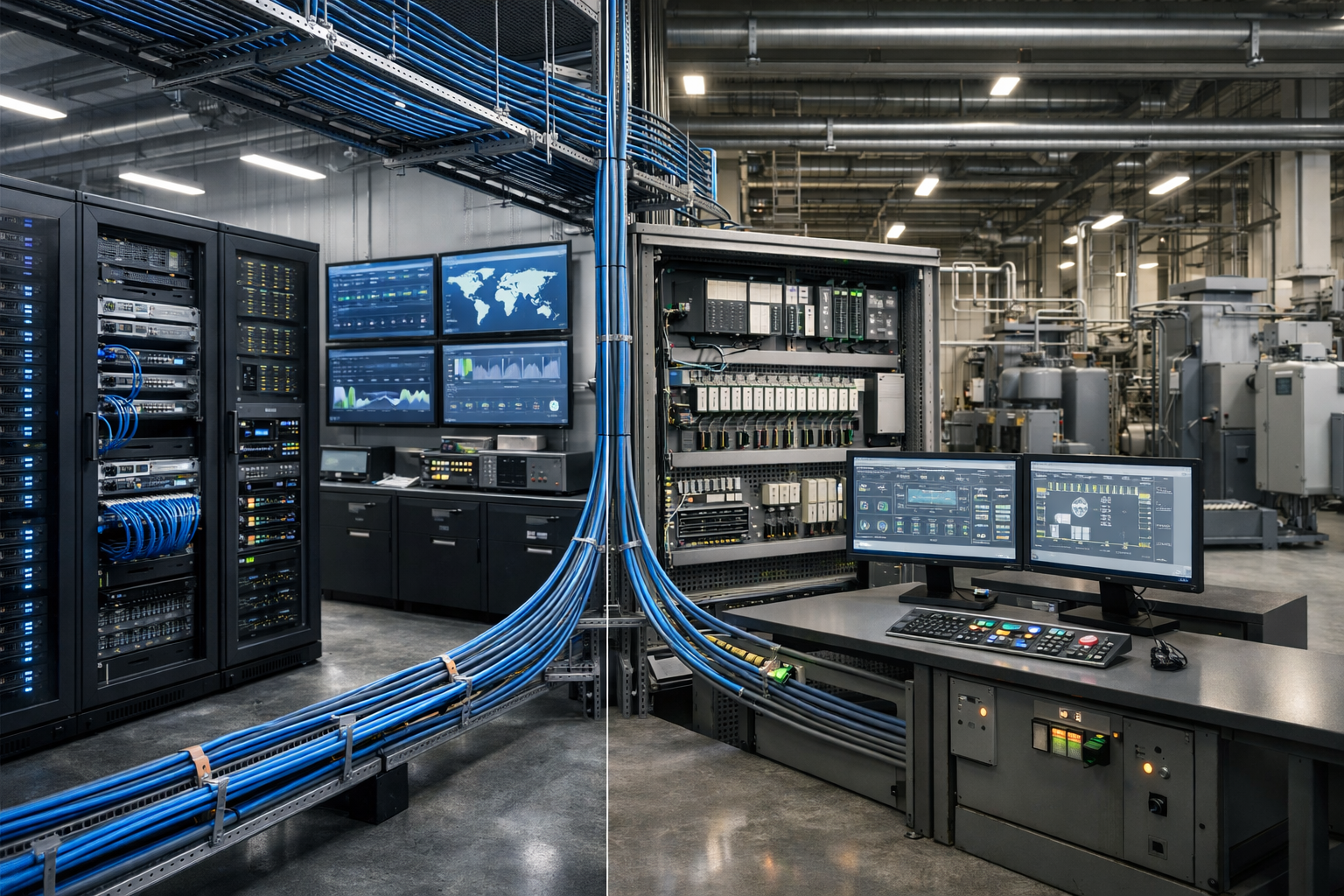
Why is NDR an ideal solution for protecting OT networks?
Operational Technology (OT) networks are the beating heart of industrial, energy, logistics, and critical infrastructure processes. Unlike traditional IT networks, where systems are more flexible and dynamic, OT environments are designed to operate with high stability, predictability, and availability.
These characteristics, which are primarily meant to guarantee operational continuity, also open the door to a particularly effective cybersecurity strategy: the use of Network Detection and Response (NDR) solutions. Below, we explore why NDR fits so well in these environments.
1. Deterministic, predictable nature
A typical OT network is made up of programmable logic controllers (PLCs), remote terminal units (RTUs), sensors, actuators, and other devices that repeatedly perform specific tasks. This produces a stable communication pattern that rarely varies.
- Low entropy: Communications follow fixed flows. Any deviation is usually significant.
- Easy to establish baselines: Because it's so predictable, an NDR solution can easily learn the system's "normal behavior."
This stability is the foundation for early threat detection through behavioral analysis.
2. Highly accurate anomaly detection
One of the pillars of NDR is the dynamic creation of traffic baselines. In OT networks, this baseline stabilizes quickly, allowing anomalies to stand out clearly:
- New traffic patterns: For example, a device that never used to communicate with another one starts doing so.
- Unusual traffic spikes: Which could indicate internal scanning or lateral movement.
- Changes in communication frequency: Often associated with malware or data exfiltration attempts.
In networks where "noise" is minimal, detecting these types of events is especially effective.
3. Passive monitoring, ideal for devices without an OS or agents
One of the biggest cybersecurity challenges in OT environments is not interfering with operations. Many industrial devices, such as PLCs or some HMIs, don't have a conventional operating system. Others, even if they do, don't allow agents to be installed, whether because they're legacy systems, due to manufacturer restrictions, or because of operational and warranty requirements.
In this context, NDR solutions provide key advantages:
- No agents required: They monitor traffic without installing software on the equipment.
- No additional traffic generated: Unlike active solutions, they don't inject data into the network.
- No alteration of the environment: They don't interfere with device operation or compromise their stability.
This makes NDR one of the few security technologies that are genuinely viable in demanding OT environments.
4. Deep, OT-specific visibility
Modern NDR solutions aren't limited to surface-level traffic analysis. They incorporate engines capable of interpreting industrial protocols such as Modbus, DNP3, OPC UA, or Siemens S7. This enables:
- Analyzing the actual content of industrial commands, not just their existence.
- Detecting anomalous or out-of-context commands, such as unauthorized write attempts or configuration changes.
- Providing operational context, which makes it possible to distinguish between an operational anomaly (like a sensor failure) and a cyber threat.
This deep understanding of the OT environment elevates the value of NDR above many generic solutions.
5. Early detection of persistent threats
Many attacks on industrial infrastructure follow a pattern: reconnaissance, lateral movement, persistence, and finally sabotage or exfiltration. In OT environments, these movements generate weak but visible signals for a well-configured NDR:
- Suspicious activity at unusual times
- New devices on closed segments
- Unusual requests to SCADA or PLC systems
Detecting these events before the attacker achieves their objective is key to maintaining the availability and security of operations.
Regulatory compliance: IEC 62443 and NIS2
Beyond the technical value that an NDR solution brings to OT environments, it's important to highlight its role in complying with international standards.
The IEC 62443 series, recognized as the global standard for industrial cybersecurity, establishes the need for continuous monitoring, anomaly detection, and network segmentation as fundamental pillars of a secure architecture.
Meanwhile, the NIS2 Directive, mandatory across the European Union since 2024, requires operators of essential services and digital providers to implement technical measures for early detection of and response to cybersecurity incidents, with particular emphasis on protecting critical infrastructure.
NDR solutions effectively cover these requirements, providing continuous surveillance and real-time alerting capability.
Conclusion: NDR as a natural ally in OT networks
The synergy between the characteristics of OT networks (stability, low variability, presence of devices without an OS, criticality) and NDR capabilities (passive monitoring, behavior-based detection, deep protocol analysis) is clear. At a time when threats to critical infrastructure are on the rise, having a system that detects anomalies without affecting operations is a necessity, not a luxury.
Adding an NDR to an OT network isn't just a sound technical decision: it's a proactive resilience strategy and an effective way to align with current regulatory frameworks.
Ewala solutions: OT protection without interference
At Ewala, these ideas are at the core of the design of SentryN3t Protection, our solution for passive monitoring and critical infrastructure cyber-protection. Want to know how it can be applied to your case? Contact us and we'll show you.