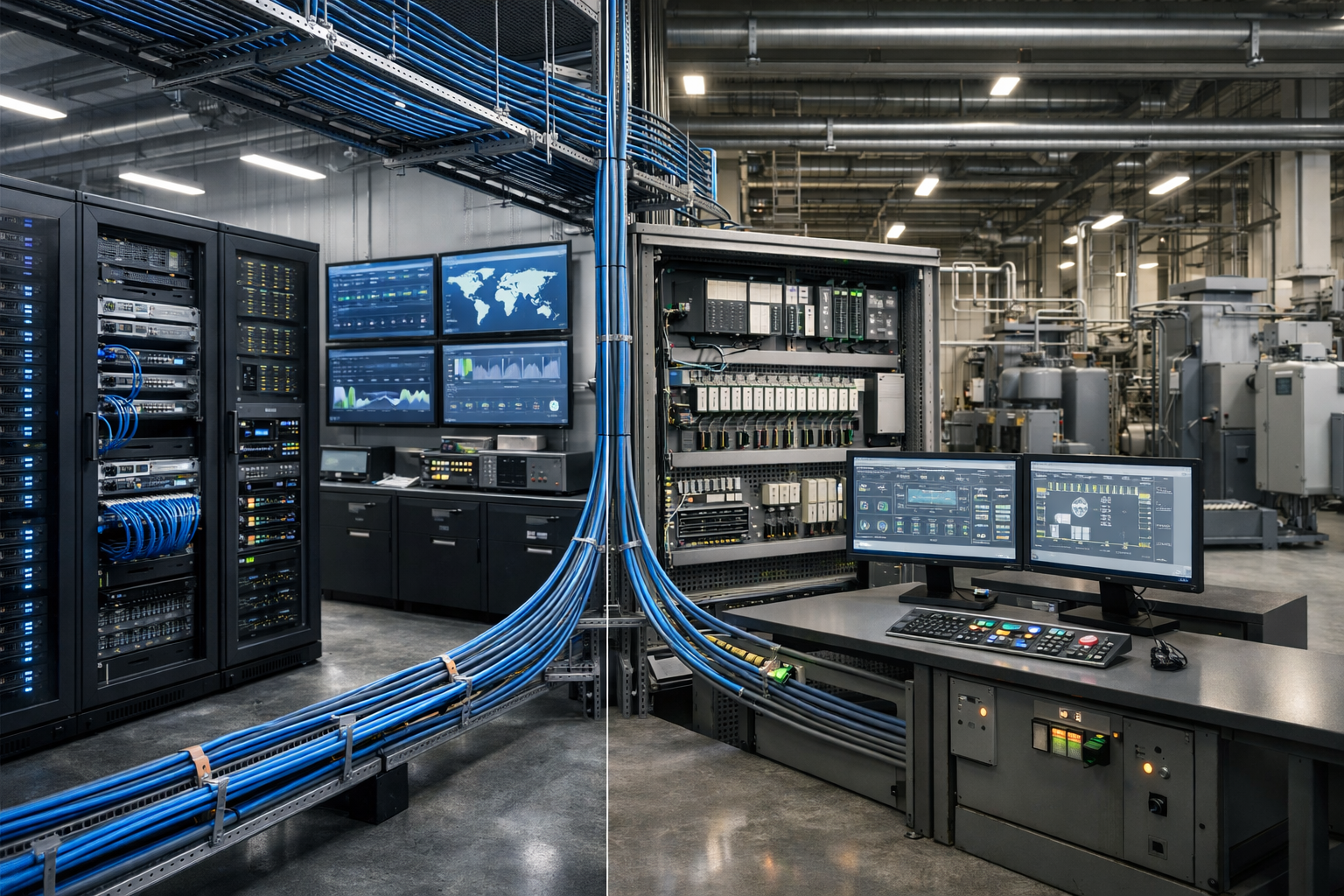
Industrial OT systems and networks
OT systems have become an essential factor on the path toward digital transformation.
At Ewala we'll walk you through the relationship between IT and OT networks, so you can understand how these networks are structured and what challenges managed cybersecurity faces in this space.
We live in an interconnected world, where it's essential to ensure the continuity and security of your business operations.
What are OT systems and networks
OT systems (Operational Technology) are the systems and technologies used to control physical processes in the real world, such as those found in industrial plants, critical infrastructure, factories, power grids, water treatment, transportation, and more.
OT networks connect sensors, PLCs, and SCADA or DCS systems, which are present across most sectors: energy, transportation, logistics, and many others.
While IT cybersecurity focuses on CONFIDENTIALITY, OT managed cybersecurity seeks to guarantee AVAILABILITY, based on physical and logical security in pursuit of continuity of operational processes.
OT devices also use their own communication protocols, specifically designed for industrial environments. These protocols enable real-time data transmission between sensors, controllers, and supervisory systems, with high reliability under demanding operating conditions. Some of the most widely used are Modbus, one of the most widespread protocols, available in variants such as Modbus RTU (serial communication) or Modbus TCP (over IP networks); PROFIBUS and PROFINET, widely used in industrial automation systems, especially with Siemens equipment; BACnet, common in building control systems; DNP3, used in electrical infrastructure; and OPC-UA, which enables more standardized and interoperable communication. However, many of these protocols were designed without modern cybersecurity requirements in mind, making them a risk vector in connected OT environments.
Differences between IT and OT networks
Before continuing, let's highlight the differences between IT and OT networks.
The former manage a company's data, prioritizing the integrity and confidentiality of information. They typically connect:
- Servers
- Storage
- Office equipment
- Communication systems
OT networks favor an approach geared toward the stability and uptime of equipment, as well as the processes they control.
Both generate tangible benefits, but not without risks; industrial OT networks were originally designed to operate in isolation, without external connectivity, so most of these networks and infrastructures lack protection against external threats.
The convergence of networks
Digital transformation in industry, driven by Industry 4.0, sensorization, and connectivity, is bringing OT systems and devices that were originally designed to operate in isolation onto the network. This evolution, while necessary to improve efficiency, productivity, and predictive maintenance, also entails a considerable increase in the attack surface. Systems that used to be disconnected are now accessible and require new protection strategies.
Physical and logical network segmentation thus becomes the first basic security measure for industrial environments. However, its implementation isn't simple, since there are numerous devices shared between IT and OT networks, which complicates their isolation. It's common to find, for example, industrial machine control equipment (such as HMIs or operator terminals) that only run on legacy operating systems, without support or the possibility of updates, making them especially vulnerable targets. These devices must be properly isolated, and it's essential to monitor all inbound and outbound traffic to and from them.
In this context, the right approach isn't to maintain total separation between IT and OT, but to move toward controlled convergence between both networks. This allows organizations to leverage the value of data generated by industrial devices to optimize processes, improve decision-making, and increase competitiveness. However, this integration must always be accompanied by specific protection mechanisms.
At Ewala, we know the best strategies to achieve effective segmentation, continuous monitoring, and security tailored to the industrial context. Because the key isn't choosing between integration or protection, but finding the smart balance between both.
Key components of an OT network
Below are the main elements that make up a modern OT architecture:
- SCADA systems (Supervisory Control and Data Acquisition): Collect real-time data and enable supervision and control of distributed industrial processes.
- DCS (Distributed Control Systems): Manage and distribute control of complex, continuous industrial processes.
- PLCs (Programmable Logic Controllers) and sensors: Automate and monitor specific physical processes with high reliability.
- HMIs (Human-Machine Interfaces): Interfaces that allow operators to interact with the processes controlled by the PLCs.
- Industrial gateways: Enable communication between OT devices and IT networks, acting as control and protocol translation points.
OT networks are characterized by their robust architecture and adaptability to the operating environment, using specific protocols such as Modbus, Profinet, or EtherNet/IP, which are very different from the standards typically used in IT networks.
Cybersecurity in IT and OT networks
At Ewala we understand OT cybersecurity as a comprehensive strategy, not a one-off action. We take a structured approach, spanning from network design to incident response, with the goal of minimizing the exposure surface to threats that compromise industrial processes and devices.
What elements make up this strategy?
Industrial Cybersecurity Management System (ICMS)
Establishes the foundations of a solid strategy tailored to the industrial environment, taking into account the specific risks associated with control systems. It allows defining policies, procedures, and controls to continuously protect OT infrastructure.
Vulnerability analysis
We carry out technical assessments of your company's devices and networks to identify weak points and critical risks. This allows prioritizing corrective actions and planning measures that strengthen security across the entire infrastructure.
Secure communications architecture
We design and optimize OT infrastructures with a 4.0 approach, prioritizing network segmentation, resilience against attacks, and scalability. A robust architecture is key to stopping internal and external threats before they affect the process.
Technology deployment
We include advanced managed cybersecurity tools and managed services that allow the client to delegate the administration and supervision of their defense systems. Solutions tailored to each environment, always updated and effective.
Incident response
Our CyberSOC service monitors OT networks in real time, detecting anomalous patterns and activating immediate response protocols. This ensures an effective reaction to any incident, minimizing the impact on operations.
Want an industrial cybersecurity strategy?
At Ewala we offer you all this and much more. We support you from the initial assessment through to the ongoing protection of your industrial assets.
Benefits of having an OT industrial cybersecurity specialist
Having an OT industrial cybersecurity specialist ensures that the protection of your systems is aligned with the particularities of the operational environment, where legacy equipment, specific protocols, and continuous availability requirements coexist. It's not just about protecting, but doing so without interrupting critical processes.
Furthermore, a specialist is key to designing segmented architectures, implementing effective monitoring solutions, and responding quickly to any incident. In an environment where an intrusion can bring production to a halt, their presence makes all the difference.
Ewala and OT systems cybersecurity
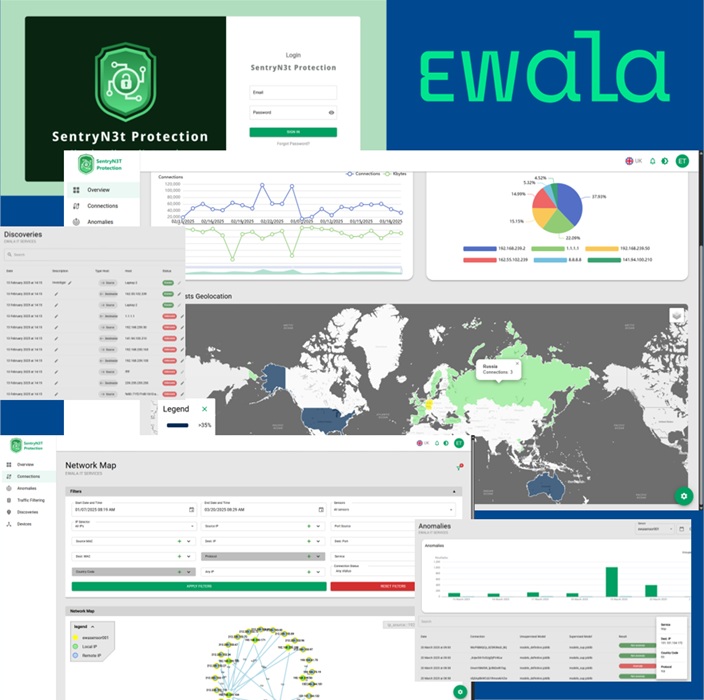
At Ewala we combine practical experience in industrial cybersecurity consulting projects with the innovative drive of our R&D&I department. This work gave rise to SentryN3t Protection, a tool developed by our team to provide full control and visibility over OT networks, adapting to the most demanding environments.
If you want to know how to protect your systems and optimize one of the best investments your company can make (investing in OT cybersecurity), don't hesitate to contact us. We'll be happy to advise you.